
A workable uniform brief for Bengaluru must account for luggage handling, restaurant spills, monsoon entrances, air-conditioned interiors, repeated laundering, and long hours on foot. By the end, you will have a role-by-role specification framework covering fabrics, construction, visibility, sizing, footwear, testing, and quantity planning.
Key takeaways
- Separate bellboy, concierge and restaurant roles before approving garments.
- Specify fabric weight, colour standard, fastness and abrasion performance in writing.
- Test walking, lifting, heat, visibility and laundering before placing a uniform order.
- Calculate sets from shift coverage, laundry turnaround and documented replacement rates.
Separate the bellboy, concierge, and restaurant-service roles before choosing garments
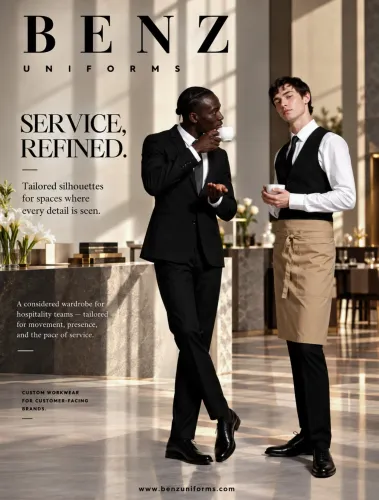
Hotel staff uniform specs for restaurant bellboy programs in Bengaluru should separate bellboys, concierge staff, and restaurant teams before selecting garments. Bellboys handle luggage, greet vehicles, escort guests, push trolleys, and coordinate valet movements, so they need mobility and abrasion resistance. Concierge staff are presentation-led and need a sharper tailored appearance.
Restaurant teams face food spills, beverage stains, kitchen heat, and frequent washing.
| Garment | Practical use | Best fit |
|---|---|---|
| Bandhgala | Formal, structured, distinctive | Concierge or ceremonial lobby duties; restrictive for lifting |
| Blazer | Tailored recognition with removable layers | Concierge; bellboy supervisors who lift less |
| Waistcoat | Smart appearance without sleeve restriction | Bellboys or concierge over a breathable shirt |
| Shirt-and-trouser set | Cool, washable, mobile | Daily bellboy and restaurant service |
| Safari suit | Pockets and relaxed movement | Outdoor-heavy bellboy duties; less suitable for formal dining |
| Lightweight tunic | Airflow and easy movement | Restaurant or resort service where local styling fits |
For Bengaluru, choose a breathable shirt with an optional waistcoat or lightweight jacket, not a permanently heavy three-piece suit. Bellboys move between vehicle areas, lobbies, lifts, and air-conditioned interiors; a removable layer prevents overheating without losing recognition.
Concierge and bellboy uniforms should prioritise tailoring, movement, reinforced high-wear areas, and rapid identification, while restaurant uniform specs should prioritise washable fabric, stain release, and quick drying. Keep restaurant neckwear short and secured where it is worn.
Write fabric and colour requirements as measurable procurement specifications
Put fibre percentage, fabric weight, weave, finish, lining, and test conditions in the schedule; “premium fabric” is not a procurement specification. For hotel staff uniform specifications in Bengaluru, set approximately 110–150 g/m² for lightweight woven shirts, 180–240 g/m² for trousers or skirts, and 220–300 g/m² for lightweight waistcoats or jackets.
Plain weave dries quickly; twill resists abrasion; lining adds structure but increases heat and drying time.
| Option | Comfort and maintenance | Best fit |
|---|---|---|
| Polyester-cotton | Cooler hand than polyester, reduced creasing, quick drying, moderate odour retention | Bellboys and restaurant shifts |
| Polyester-viscose | Smooth drape, strong crease resistance, efficient ironing, can retain odour | Concierge and presentation-led roles |
| 100% cotton | Soft and breathable, but creases, shrinks, dries slowly, and holds stains | Short indoor shifts with controlled laundering |
| Linen blend | Airy and comfortable, but creases and wears at high-friction points | Outdoor greeting in hot periods |
| Stretch blend | Improves reach and trolley handling, but requires recovery and seam testing | Bellboys lifting luggage |
State exact percentages, such as 60% polyester and 40% cotton; “cotton-rich” permits inconsistent bids. A stain-release finish can reduce restaurant maintenance, while resin finishes can alter breathability and hand.
Approve a physical colour standard or signed lab dip, not “hotel navy.” Include these checks in the restaurant uniform specs:
- Shade change after washing
- Dry and wet crocking onto light fabric
- Perspiration fastness
- Chlorine and oxygen-bleach exposure
- Contrast piping, embroidery, and logo adhesion after laundering
Use lighter, faster-drying fabrics for outdoor bellboy shifts and washable, stain-releasing blends for restaurant service. Select tailored, crease-resistant cloth for concierge staff.
Build movement, visibility, and safety into every garment component
A bellboy jacket that looks sharp but restricts a shoulder while lifting luggage will fail on its first busy shift. Specify shaped armholes, back pleats or action-back construction, and enough shoulder and bicep ease for trolley pushing, door opening, and guest escorting.
Write these construction points into the concierge and bellboy uniforms specification:
- Use a mid-rise trouser with adequate seat and thigh ease; add stretch panels only where they do not weaken the garment.
- Reinforce pocket openings, side seams, trouser seats, and jacket hems with suitable stitching or bartacks.
- Provide secure, closed pockets for keys, phones, and small tools; reject loose flaps or openings that spill contents while bending.
- Test jacket hems and pocket edges against trolley handles, vehicle doors, and luggage corners.
Use contrast piping, a department-colour tab, or a restrained cap detail to identify bellboys at the entrance. Place an embroidered or metal logo 25–40 mm above the wearer’s left chest pocket line, or on the upper sleeve with its centre 80–100 mm below the shoulder seam.
Keep the name badge 10–20 mm above the opposite pocket line, and avoid oversized logos, projecting pins, loose lanyards, and dangling cords. Distinguish bellboys from security and valet staff through colour and department wording.
Restaurant uniform specs should treat neckwear separately: choose a short secured format, with breakaway or safety treatment where the risk assessment requires it. Specify closed-toe, secure-heel footwear with slip resistance, cleanable uppers, prolonged-standing comfort, and soles tested not to mark wet monsoon entrances or lobby floors.
Turn sizing, care, and wear testing into a supplier approval process
Approve the sample only after a Bengaluru wearer set has been measured and fitted. The size schedule must record chest, waist, hip, shoulder, sleeve, inseam, and finished garment lengths, with garment-by-garment tolerances; imported S/M/L labels conceal fit differences and create costly alterations.
| Block | Separate approval requirement | Failure prevented |
|---|---|---|
| Women’s | Body-shape, bust, hip, and alteration allowances | Pulling, gaping, and excess alteration |
| Men’s | Chest, shoulder, sleeve, waist, and seat balance | Restricted movement and poor drape |
| Unisex | Tested proportions, not shared nominal sizes | One group receiving an ill-fitting cut |
| Alteration | Approved intake, hem, sleeve, and waist limits | Inconsistent site alterations |
That measurement discipline forms reliable hotel staff uniform specifications in Bengaluru. It also gives a hotel uniform supplier serving restaurant teams a basis for reproducing fit across sizes.
Write the laundering brief before production: name the wash temperature, detergent, cycle, drying method, pressing temperature, and maximum dimensional change for fabric, trim, lining, embroidery, contrast panels, and fusible interlining. Set the limits in the contract, such as ±2% for body fabric where the design permits, then verify each component separately.
Care labels must use ISO 3758 symbols and match that approved process.
Run a representative pilot across real shifts, not a new-garment inspection. Record:
- Seam opening, pilling, shrinkage, colour migration, logo adhesion, and button loss
- Stain release, odour retention, and comfort after bellboy and restaurant-service shifts
BENZ UNIFORMS can be assessed on technical samples, documented results, alteration support, and production consistency rather than photographs.
Calculate quantities and replacement needs from shifts, laundry, and wear rates
For hotel staff uniform specs for restaurant bellboy programs in Bengaluru, calculate by staffed shifts, not headcount. One set per employee fails during laundry, weekly days off, leave, onboarding, or a damaged garment.
Use: required sets = one set per staffed shift + laundry-turnaround allowance + days-off and leave allowance + onboarding sets + replacement reserve.
- Build separate counts for bellboys and restaurant teams. Bellboys need higher reserves for luggage abrasion, driveway dirt, vehicle-area grime, and monsoon exposure; restaurant teams need more shirts and trousers for food and beverage spills.
- Add spare pieces, not only complete outfits: shirts, trousers, waistcoats, jackets, badges, buttons, and branded trims. A failed button should not remove an entire uniform from service.
- Increase rotation where staff walk or use two-wheelers. Wet garments need drying capacity, and saturated monsoon footwear needs a second wearable pair; replace footwear by sole wear, loss of slip resistance, cracking, or persistent odour.
- Run the model through a wear-and-launder pilot, then adjust soil and replacement rates separately for each role.
Before a bulk purchase order, approve the role matrix, fibre composition, GSM, colour standard, construction details, size tolerances, care symbols, pilot results, and quantity model. A hotel uniform supplier restaurant teams brief must record these decisions, including laundry turnaround and monsoon drying capacity.
Frequently asked questions
How should bellboy, concierge and restaurant-service uniforms differ?
Give bellboys mobility, abrasion resistance and visible role identification; use sharper tailoring for concierge staff; prioritise stain control, movement and washability for restaurant teams.
What should hotel uniform specifications include?
Specify fibre composition, fabric weight, colour reference, colourfastness, seam construction, closures, trims, embroidery placement, size measurements and care instructions.
How can a hotel test uniforms before supplier approval?
Run wear tests covering walking, lifting luggage, reaching, sitting, heat exposure, visibility, laundering and seam or button failure, then record defects by garment and size.
How many uniform sets does each employee need?
Base the quantity on shifts, laundry turnaround, weekly days worked, drying time and the replacement rate recorded during the trial period.