
A five-star rating does not define a housekeeping garment, its fabric, or its laundering limits. Hotels get better results by assigning clothing to real tasks and roles, testing garments under working conditions, and managing replacements as carefully as the initial order. By the end, readers will know how to brief, test, approve, launder, and replenish housekeeping uniforms.
Key takeaways
- Build uniforms around each role’s tasks, risks, guest contact and work environment.
- Test garments during bending, kneeling, reaching, wet work and chemical handling.
- Specify fabric alongside branding, PPE compatibility, laundering and replacement requirements.
- Approve stock levels and replacement rules before uniforms enter daily hotel use.
What Five-Star Housekeeping Uniforms Include by Role
Five star hotel housekeeping uniforms are a role-based set, not one identical outfit. Start with a task-and-risk matrix covering shift, guest contact, work area, wet work, chemicals, heat, kneeling, repetitive reaching and soiled materials.
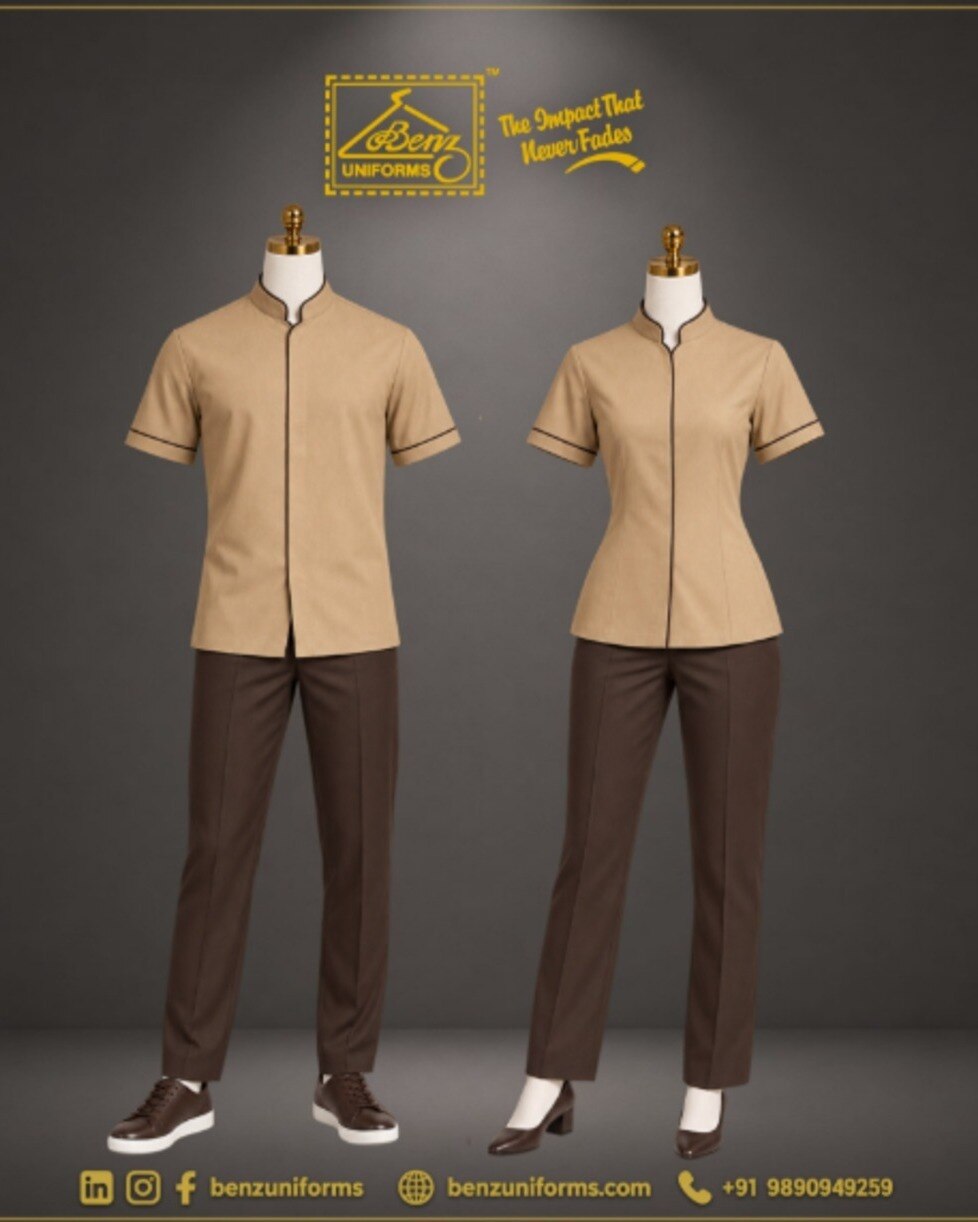
1. Room attendants usually wear a tunic or collared shirt with trousers, an apron for room and bathroom work, a visible name badge and a housekeeping department identifier. Choose trousers or skirts only when they permit bending, stair use and trolley movement; pair either option with approved, slip-resistant footwear.
2. Public-area attendants need the same visible department identity but clothing suited to longer guest-facing periods, floor machines, wet floors and frequent movement. Keep pockets secure and ensure hems do not interfere with safety footwear.
3. Laundry staff need tunics or shirts, trousers and aprons compatible with heat, moisture, lint and handling used linen. Add task-specific gloves, eye protection or protective aprons when the product safety data sheet and risk assessment require them.
4. Turndown teams need a polished shirt or tunic, trousers or skirt, name badge and low-profile apron suited to evening guest contact. Supervisors can add a contrasting layer, such as a vest, cardigan or jacket, so guests and staff can identify authority quickly.
5. Executive housekeepers usually wear a more formal shirt, blouse, trousers, skirt, jacket or coordinated layer, with a name badge and department identifier.
Five-star status is a service classification, not a textile-performance standard. Write requirements for fit, laundering, chemical exposure, footwear compatibility and appearance into the brief before selecting five star hotel housekeeping uniforms or other housekeeping work uniforms.
The Hotel Housekeeping Uniform Process from Brief to Delivery
Start with a written departmental brief, not a catalogue style. The hotel housekeeping uniform process should document:
- Staff numbers by role, shift patterns, complete sets per employee, permitted changes per shift, laundry turnaround, spare stock, new-starter needs, weekends, public holidays, damaged garments and size exchanges.
- Role and task mapping for room attendants, public-area cleaners, laundry staff, turndown teams, supervisors and executive housekeepers.
- A risk assessment covering wet work, chemicals, heat, kneeling, repetitive reaching, soiled materials and guest contact. Specify protective equipment separately from the uniform, using each chemical’s safety data sheet.
- Fabric and trim selection against laundering, opacity, movement, drying, colour retention, pocket security and snag risk.
- Design approval, followed by graded size sets covering the agreed measurement range.
- Wearer trials during bending, reaching, kneeling, trolley movement and stair use, then a wash and finishing trial.
- Sampling with corrected patterns, recorded approved measurements and a pre-production sample carrying final branding.
- Bulk production after approval, with batch inspection for measurements, shade, stitching, branding, fasteners and packaging.
- Delivery by role and size, with clean-stock quantities reconciled against the brief.
- Replacement orders using the approved pattern, measurements, trims and branding, rather than treating each reorder as a new design.
A specialist hotel uniform manufacturer translates task requirements into patterns, coordinates size sets and preserves consistency when staff change size or garments wear out. Hotels evaluating a uniform manufacturer for 5 star hotels housekeeping uniform use could compare this control process with BENZ UNIFORMS and other suppliers.
Keep approved size and alteration records for every replacement order.
How to Test Housekeeping Garments During Real Hotel Tasks
A standing fitting misses the strain, reach and coverage failures that appear during housekeeping work uniforms. Run a wearer trial with different body shapes and both women’s and men’s blocks, using the hotel’s actual staff.
- Bend to tuck sheets and reach across a bed without shoulder or hip restriction.
- Kneel beside a bathroom floor and squat without waistband pressure or exposed waist.
- Push a loaded trolley, climb stairs and lift a linen bundle without restricted breathing.
- Answer a guest while the collar, hem and back remain covered and presentable.
| Feature | Check during the trial | Failure to reject |
|---|---|---|
| Movement | Shoulders and hips move freely through each task | Pulling, binding or shortened reach |
| Back and waistband | Stretch accommodates bending and squatting | Exposed waist or breathing restriction |
| Sleeves and collar | Sleeves cover wrists; collar stays comfortable | Dragging cuffs, choking or skin irritation |
| Pockets and fasteners | Pockets stay secure; closures sit flat | Spilled keys, scratches or snagging |
| Seams and hems | Stress points hold; hems remain stable | Splitting seams or creeping hems |
| Opacity and footwear | Coverage remains opaque; trousers work with approved shoes | Visible underwear or unsafe trouser break |
Polished styling has a practical limit. Decorative cords, metal details and raised trims add snagging, heat, weight, hard contact points and laundering effort.
Choose low-profile fasteners, reinforced seams and secure pocket positions when they protect work performance; compare the final sample against five star hotel housekeeping uniforms used in real rooms, not against a static fashion sample.
How Fabric, Branding, PPE, and Laundry Requirements Change the Specification
Specify performance before choosing a fabric or colour. For housekeeping work uniforms, require breathability in warm rooms, visible but manageable stain contrast, rapid drying, opacity during bending, low pilling, limited dimensional change, secure seams, and resistance to repeated industrial laundering. “Five-star” describes service level, not textile performance.
1. Record the fabric targets: colourfastness after laundering and perspiration, seam performance, pilling, opacity, dimensional change, drying time, and appearance after the agreed wash cycles.
2. Write the actual laundry route into the specification: wash temperature, detergent and alkali chemistry, chlorine or oxygen bleach policy, extraction, tumble-drying temperature, pressing, tunnel finishing, and target number of wash cycles. Require testing under ISO 15797 procedures; a domestic “machine washable” claim does not predict survival under commercial heat, chemistry, extraction, or finishing.
3. Test a complete branded sample, not the plain garment. Launder the embroidery, heat transfers, badges, labels, contrast panels, backing, and thread with the garment, then check shrinkage, cracking, bleeding, snagging, peeling, hard contact points, and colour change.
4. Reconcile every care label with the commercial laundry’s documented process. Reject a label that permits only domestic washing when the hotel’s route uses tunnel finishing or harsher chemistry.
5. Separate uniform design from protective equipment. The product safety data sheet and workplace risk assessment determine chemical-resistant gloves, eye protection, chemical-resistant aprons, and footwear; a uniform manufacturer for 5 star hotels housekeeping uniform use must not present clothing as chemical PPE.
6. Approve the final specification, including replacement fabric, trims, branding method, and test records, before placing bulk orders.
How Hotels Manage Uniform Use, Stock, and Replacement After Approval
After approval, treat uniforms as controlled stock, not a one-time purchase. Room attendants wear them through room cleaning, bed making, bathroom sanitation, waste handling, trolley movement, stair use, and guest questions; turndown staff need the same mobility with a presentation standard suited to evening service.
Laundry staff require separation from wet, hot, or soiled work, while supervisors need identifiable layers.
Remove any garment immediately when it is visibly soiled, torn, heavily stained, loose at a seam, or no longer safe around equipment. Place used garments in marked collection bins, never with clean stock; issue task-specific gloves, eye protection, chemical-resistant aprons, and footwear from the safety data sheet and risk assessment, not from the uniform specification.
For each role, calculate complete sets as: employees per shift × shift pattern × permitted changes per shift, then add sets covering laundry turnaround, weekends, public holidays, repairs, new starters, and a size-exchange reserve. Record separate quantities for room attendants, public-area cleaners, laundry staff, turndown teams, and supervisors in the hotel housekeeping uniform process.
Compare replacement choices against evidence, not decorative appearance or a fibre claim alone.
| Criterion | Compare | Replacement decision |
|---|---|---|
| Repairability and service life | Replaceable buttons, seams, panels, and months of usable wear | Repair when practical; replace recurring failures |
| Wash-cycle durability and colour fading | Tested cycles, dimensional stability, shade loss | Reject rapid fading or shrinkage |
| Fibre shedding and packaging | Shedding evidence and packaging volume | Prefer lower waste across the full system |
| End-of-life route | Take-back, reuse, recycling, or disposal instructions | Choose the documented route with least avoidable waste |
Frequently asked questions
What should five-star hotel housekeeping uniforms include by role?
Create a role-based set for room attendants, public-area attendants, laundry staff, supervisors and housemen. Match each uniform to guest contact, cleaning tasks, wet work, chemicals, heat, kneeling, reaching and soiled materials.
What is the hotel housekeeping uniform process from brief to delivery?
Start with a task-and-risk matrix, define garments and branding, review samples, test them during real hotel tasks, approve the specification, and confirm quantities, sizing, delivery and replacement arrangements.
How should hotels test housekeeping work uniforms?
Have staff wear samples while bending, kneeling, reaching, pushing carts, handling wet materials, using cleaning chemicals and moving between guest and service areas. Record comfort, mobility, coverage, fastener performance and laundering results.
How do fabric, branding, PPE and laundry requirements affect the specification?
Choose fabric for movement, heat, moisture, durability and the hotel’s wash process. Check that logos survive laundering, garments work with required gloves or other PPE, and colours and trims remain suitable for guest-facing areas.
How do hotels manage uniform stock and replacement after approval?
Set an issue quantity by role and shift, keep size records, define spare stock, inspect returned garments, and replace items when they are damaged, permanently stained, incorrectly sized or no longer presentable.