
A jacket that looks correct on a stationary chef can restrict reaching, expose the wrist, catch on equipment or open during a lift. By the end, you will have a practical fit checklist, movement test and approval process that accounts for body shape, laundering, protective layers and long kitchen shifts.
Key takeaways
- Measure nine body points and compare them with finished-garment measurements.
- Test reaching, rotating and bending before approving a chef jacket.
- Check cuffs, closures and trouser hems for safety and hygiene risks.
- Repeat the fit review after laundering and drying the uniform.
What should a five-star chef uniform fit checklist measure?
Approve a chef uniform only after measuring nine points on the wearer and the finished garment. A tape records the body; a finished-garment measurement is taken across the actual jacket or trousers laid flat. One static chest number misses the movement behind chef uniform poor fit: reaching, rotating and bending expose armhole and upper-back restrictions.
Different bust, waist, hip and shoulder proportions may need separate blocks or alterations, not simply a larger size.
- Shoulder width
- Chest ease
- Sleeve length
- Cuff position
- Jacket length
- Collar clearance
- Trouser rise
- Waistband tension
- Hem length
| Checkpoint | Body measurement | Finished-garment inspection | Warning sign |
|---|---|---|---|
| Shoulder width | Shoulder point to shoulder point | Seam alignment across the jacket | Seam extends beyond the shoulder point |
| Chest ease | Chest circumference | Jacket circumference minus body measurement | Horizontal strain lines across chest or upper back |
| Sleeve length | Shoulder point to wrist | Shoulder seam to cuff edge | Cuff covers the hand |
| Cuff position | Wrist location | Cuff against the wrist with arms extended | Cuff catches equipment or restricts movement |
| Jacket length | Waist and hip landmarks | Jacket hem relative to apron | Jacket lifts above the apron |
| Collar clearance | Neck circumference | Space between collar and neck | Collar presses into the neck |
| Trouser rise | Waist to seated crotch | Front and back rise in the trousers | Binding during bending |
| Waistband tension | Natural waist circumference | Fastened waistband under apron ties | Waistband digs in or gaps |
| Hem length | Floor-to-ankle measurement | Trouser hem over footwear | Hem touches a wet floor or drags under footwear |
These checks catch five star chef uniform problems before they become shift failures.
Which five poor-fit problems disrupt a hotel kitchen shift?
A jacket that looks correct while standing still can fail within minutes of reaching, bending or turning. A uniform manufacturer for 5 star hotels must treat chef uniform fit problems as movement failures, not styling defects.
| Problem | Working warning sign | What goes wrong |
|---|---|---|
| Restricted shoulders or narrow armholes | Pulling across the upper back when reaching forward or crossing both arms | Movement becomes tiring, and the chef may leave closures undone |
| Sleeves too long or too narrow | Cuffs enter food or catch pan handles; bent elbows feel tight | Fabric becomes contaminated, while restricted elbow flexion slows handling |
| Loose cuffs | Fabric hangs near flames, burners, mixers or knives | The cuff can snag, expose the wrist or contact a hot surface |
| Poor jacket length or front balance | The lower front opens during bending, or double-breasted overlap feels bulky | The apron system loses coverage; excessive overlap traps heat and bulk |
| Incorrect trouser waist or rise | The waistband slips, binds during squats or rolls beneath apron ties | Repeated adjustment interrupts work and excess fabric obstructs movement |
Check the second problem with the elbow bent and forearm extended: the cuff must clear the hand while preserving required glove overlap. Check the jacket and trousers together, because a short jacket can expose the lower back and a long, full one can bunch beneath the apron.
These hotel kitchen uniform issues reveal fit more reliably than a mirror. Tightness shows as pulling or binding; looseness shows as slipping, gaping or snagging; short garments expose coverage gaps; long garments create drag, heat and contamination risk.
How do you test a chef jacket in real kitchen movements?
A chef uniform poor fit is not proved by a buttoned jacket in front of a mirror. Test the complete system: undershirt, chef jacket, trousers, apron and required protective equipment, with every closure fastened.
1. Reach overhead, extend both arms forward, then cross them across the chest. Stop if the armholes pull, horizontal strain lines appear, buttons strain or the upper back restricts movement.
2. Bend as if lifting an imaginary stockpot, twist at the pass and crouch beside low refrigeration. Check that the collar allows head movement, the waistband does not dig in, the trouser rise does not bind and the jacket does not ride above the apron.
3. Hold the normal plating position for several seconds. Confirm that the cuff finishes clear of the hand, leaves room for required glove overlap and cannot enter food, catch a handle or approach a flame.
4. Compare the double-breasted front while moving, not while standing upright. Excessive overlap adds chest heat and bulk; insufficient overlap allows gaping when the wearer bends or reaches.
5. Adjust jacket length, trouser rise and apron together. Keep enough movement ease for lifting and rotation, but do not solve restriction by starting with an oversized garment: excess fabric increases heat, snagging and bulk beneath apron ties.
This sequence exposes five-star chef uniform problems that a static chest measurement misses, including a short jacket that exposes the lower back and trousers that shift during a long service.
How does poor fit create safety and hygiene exposure?
A sleeve that reaches a burner, oven door or hot pan creates a hazard before it looks obviously oversized. Excess fabric can catch a handle, brush food or drag through steam; a loose cuff can approach flames, knives or a mixer.
Dragging trouser hems collect moisture and debris, then turn a wet floor into a trip risk.
Heat makes tight clothing dangerous too. Tight armholes and collars increase pressure, so chefs roll sleeves, leave closures undone or remove layers. A gaping front or exposed wrist weakens the barrier against food, splashes and hot surfaces.
Bulky fabric also slows a contaminated-garment change, creating avoidable hotel kitchen uniform issues and five star chef uniform problems.
After a spill or splash, check these points:
- Can the jacket be removed without pulling contamination across the face or hands?
- Do the buttons, snaps or front-placket closures still open and close without forcing?
- Does the replacement size preserve reach, elbow flexion and glove overlap?
- Does the cuff remain clear of food, flame, blades and mixer attachments?
- Do trouser hems stay above the wet floor while walking and crouching?
Recheck fit after the hotel’s repeated wash, high-temperature drying and pressing cycle. Collar shrinkage can cause rubbing and undone closures; sleeve distortion can expose wrists or restrict movement; front-placket damage can create gaps. A jacket that fitted initially becomes a recurring hygiene problem when laundering changes its dimensions.
How should a hotel approve fit after body measurement and laundering?
Approve the range only after representative staff have worn and laundered it. Record chest, waist, hip, shoulder, neck, arm, inseam, rise and height measurements, then compare them with finished-garment dimensions and the intended allowance for shirts, thermal layers or other base clothing.
1. Select chefs, sous-chefs, pastry chefs, stewards and kitchen porters across petite, tall, broad-shouldered, fuller-busted and larger-waisted proportions. Do not approve a nominal medium or large alone; inspect shoulder balance, armhole position, trouser rise and hem length across the run.
2. Fit the complete sample with its actual embroidery, piping, reinforced panels, buttons and trim. Record overhead reach, forward reach, crossed arms, bending, twisting and crouching results, because dense chest embroidery or heavy front details can stiffen fabric and pull the placket downward.
3. Send every approval sample through the hotel’s real wash, high-temperature drying and industrial pressing cycle. Afterward, recheck sleeve length, collar clearance, inseam, placket shape and seam balance. A jacket that passed before laundering can develop a tight collar, short sleeve or distorted front.
4. Classify the fault before requesting changes. Repeated tight armholes or short sleeves in one size indicate a block or grading problem; complaints across different body areas indicate missing size options or required alterations.
A chef uniform manufacturer such as BENZ UNIFORMS can act on useful evidence when you provide measurements, laundry conditions, decoration details and movement-test results. For a uniform manufacturer for 5 star hotels, chef uniform fit problems become solvable data rather than guesses from a generic size chart.
Related product
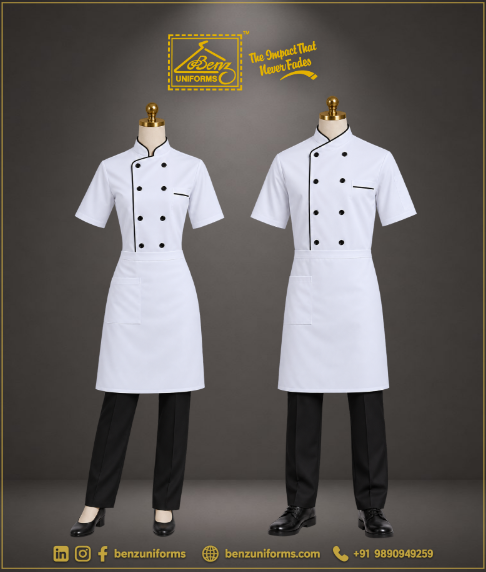 | Chef Uniforms Benz Uniforms: Elevate Your Kitchen with Professional Chef Uniforms At Benz Uniforms, we understand that a chef's attire is more than just... View product → |
Frequently asked questions
What should a five-star chef uniform fit checklist measure?
Measure nine body points, then compare them with the finished jacket and trousers: chest, waist, hip, shoulder, sleeve, armhole, back length, inseam and outseam.
Which five poor-fit problems disrupt a hotel kitchen shift?
The main problems are restricted arm movement, shoulder strain, gaping closures, sleeves that interfere with work and trousers that bind or drag.
How do you test a chef jacket in real kitchen movements?
Test overhead reaching, forward reaching, torso rotation, bending, squatting and lifting while checking the armholes, back, closures and cuffs.
How does poor fit create safety and hygiene exposure?
Loose cuffs can catch equipment, dragging hems collect contamination, tight closures expose clothing and restricted movement can cause spills or strain.
How should a hotel approve fit after body measurement and laundering?
Approve a sample after movement testing, wash and dry it using the intended care process, then repeat measurements and checks before bulk production.