
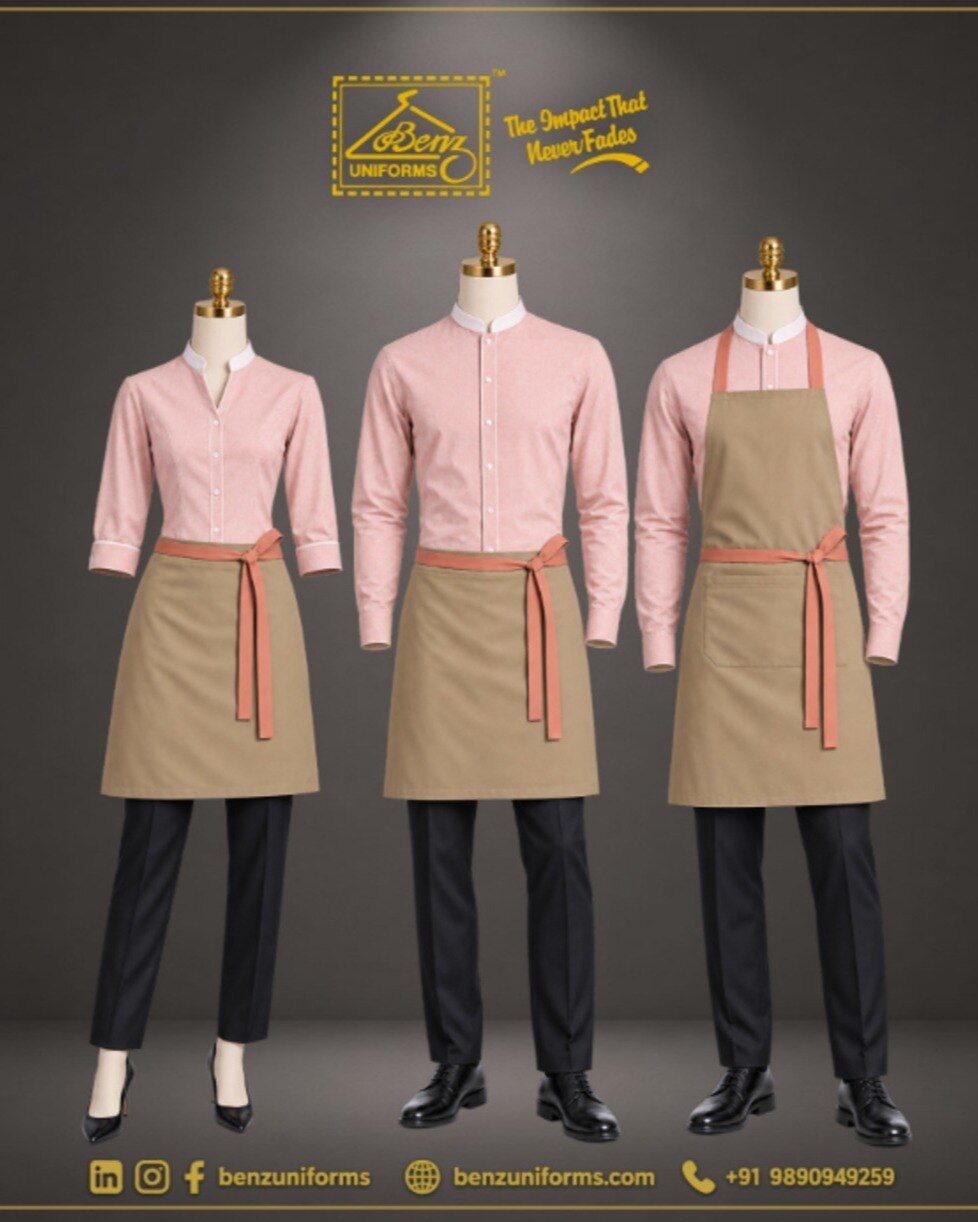
A collar that rolls, a waistband that relaxes or a trouser knee that bags is not always a sign that the fabric has shrunk. By separating laundering damage, poor fit, construction failure and normal end-of-life wear, you can correct the cause and replace garments before appearance or movement becomes a service problem.
Key takeaways
- Reinforce elbows, knees, seat seams and stress points exposed to repeated movement.
- Choose stable fabrics, shaped construction and enough ease for bending and reaching.
- Check laundering, heat and pressing before replacing a misshapen garment.
- Replace uniforms when shrinkage, seam failure or permanent distortion affects presentation.
What repeated restaurant movement does to a uniform
A long restaurant shift bends, reaches, carries trays and kneels hundreds of times, loading the same garment areas again and again. Heat and perspiration soften fibres temporarily, while counters, tables and aprons abrade surfaces; frequent washing, drying and pressing add dimensional change and stress.
The first warning points in hotel staff uniforms are:
- Shirt collar points and stands, cuffs, shoulder seams and elbow zones
- Pocket openings, jacket fronts, waistbands, trouser seats and knees
- Apron-contact zones, hems and elastic sections
This pattern explains much of hotel dining uniform wear. A cuff may spread from reaching, a trouser seat may bag from sitting and bending, and a shoulder seam may widen when a tight armhole pulls against it. Intact sewing thread does not rule out seam slippage: fabric yarns can migrate beside the seam.
Fused collars, cuffs, waistbands and plackets can also bubble after repeated heat, moisture and pressing.
Do not treat every visible change as permanent deformation. Wrinkling or moisture-related sagging that disappears after complete drying and correct pressing is temporary; poor pressing can create the same appearance. Permanent fabric bagging, relaxed elastic, seam slippage, bubbling or dimensional shrinkage remains after drying and pressing.
Measure before replacing the garment, because changing uniforms will not fix excessive heat, a poor fit, incompatible fusing or an aggressive laundry process.
Which fabric, construction and fit choices protect shape
Polyester-cotton is a practical baseline for restaurant uniform durability: it balances recovery, breathability and wash tolerance. Polyester-viscose drapes neatly and resists creasing, but heat and perspiration can expose odour retention. Cotton-rich cloth feels cooler and absorbs moisture, yet shrinks, wrinkles and holds food stains more readily.
Fabric choice changes the failure you see.
| Option | Shape retention | Breathability, heat, stains and odour |
|---|---|---|
| Polyester-cotton | Good recovery; moderate bagging | Moderate breathability; handles heat well; stains can cling; moderate odour |
| Polyester-viscose | Good drape; moderate recovery | Less breathable; heat can flatten the finish; hides wrinkles; can retain odour |
| Cotton-rich | Lower after repeated washing | Breathable but moisture-heavy; heat-sensitive; stains and wrinkles show; odour washes out readily |
| Stretch blend | Good movement, until elastane loses recovery | Comfortable in heat; elastane suffers from heat and oxidising bleach; stains depend on the base fibre; odour varies |
| Synthetic performance fabric | Strong recovery and quick drying | Handles perspiration and heat well; stain release varies; odour can persist in fibres |
Woven shirts resist visible bagging better than knits because their yarns cross in a stable structure. Wovens can still develop seam slippage, puckering or fused-interlining bubbles; knits can lose torque and recovery at collars, cuffs and openings.
Ask for the following before approving a sample:
- Fabric weight, fibre percentages, elastane content, weave and stretch-recovery result.
- Adequate seam allowance, close stitch density, reinforcement at pockets and stress points, plus stable interfacing and lining.
- Secure button and zip attachment, not decorative stitching that pulls away during service.
Avoid tight armholes, short sleeves, strained buttons, low-rise trousers and overlarge shoulders. Each forces distortion when staff reach, bend or carry trays.
How to diagnose the cause before replacing a garment
Measure length and width separately before diagnosing hotel dining uniform wear. Record body length and width, sleeve length and width, collar length and circumference, chest, trouser inseam and waistband, then compare each figure with the original size record. Overall size can look unchanged while a collar or pocket distorts.
- Photograph collar points, cuffs, side seams, armholes, pockets, knees, hems, fused areas and elastic sections before laundering.
- Repeat the photographs and measurements after laundering, ideally after 5, 10 and 20 cycles, using the same flat surface, garment position and measuring points.
- Check a widening seam without broken thread: fabric yarns have migrated, indicating seam slippage rather than seam breakage.
- Check bubbles under a collar, cuff or placket: the fused interlining has failed.
- Check a permanent shiny patch: abrasion has polished the fabric surface.
- Stretch the waistband and release it. If it does not return, suspect elastic fatigue or heat damage.
| Finding | Classification | Corrective decision |
|---|---|---|
| Dimensional change after washing | Laundering problem | Review temperature, drying and pressing |
| Strained buttons, tight armholes or distorted panels | Fit problem | Correct the pattern or size |
| Seam slippage, bubbling or failed attachment | Construction failure | Review seam allowance, interfacing or stitching |
| Holes, permanent stains or irreversible deformation | End-of-life wear | Proceed with restaurant uniform replacement |
This record stops a replacement from concealing a recurring process error.
How to maintain shape through washing, drying and pressing
Start with the care label: it sets the maximum washing temperature, bleach permission, tumble-dryer setting and ironing temperature. Match that instruction to your actual restaurant staff maintenance route, whether domestic, on-premise commercial or outsourced industrial laundry.
1. Record the intended wash formula and test it on the real kitchen soil load: grease, perspiration and food residue. Use the least aggressive validated process that removes those soils.
Strong alkalinity, chlorine or oxygen bleach, solvent action, prolonged chemical exposure, high temperature and excessive mechanical action can fade colour, damage finishes, shrink cotton-containing fabric and reduce elastane recovery.
2. Dry at the label’s setting. Air-dry a garment when the label prohibits tumble drying or when heat threatens elastic waistbands, stretch panels or fitted areas; otherwise use the permitted low-heat setting.
High commercial finishing heat is not equivalent to “tumble dry low” and can shrink fabric, damage elastic and set residual oil or protein stains.
3. Reshape each garment while damp: align side seams, smooth collars and cuffs, restore pocket edges and straighten the waistband before hanging. Steam relaxes fibres with little direct pressure; pressing adds heat and compression.
Keep a hot iron away from fused collars, lapels and facings, because excessive heat can bubble the adhesive interlining or create shine.
4. Rotate four serviceable sets through a five-shift week instead of relying on two. Each set receives fewer wash cycles, reducing dimensional change and finish wear; the benefit depends on keeping all four sets available in the correct sizes.
When to test, replace or specify a different uniform
Replace a garment when damage threatens serviceability, not simply because it looks tired. Holes, exposed or distorted seams, permanent oil or bleach marks, delaminated fused parts, nonrecovering waistbands, uncorrectable collar roll, or dimensional change that restricts fit and safe movement all justify restaurant uniform replacement.
- Record each trial garment’s body length, chest, sleeve, trouser inseam, collar and waistband measurements, plus photographs, before washing.
- Wash samples through the intended domestic, on-premise commercial or industrial laundry route, then repeat the records after at least 5, 10 and 20 cycles. Set an acceptable change for every measurement instead of relying on a general visual pass.
- Use ISO 5077 dimensional-change testing alongside appearance ratings. This separates shrinkage from bagging, seam failure and fused-part damage.
- Specify the wash formula, drying temperature, pressing method, target service cycles, fabric weight, fibre blend, stretch content, colourfastness expectations and replacement-stock sizes. Change the uniform specification when the trial fails under the real care process.
These records turn restaurant uniform durability into a purchasing decision. They also give a supplier a usable brief: BENZ UNIFORMS can work from operating specifications for hotel staff uniforms rather than a vague request for “durable” garments.
Keep replacement stock in the sizes that the trial and staff measurements actually show, not only the sizes ordered at launch.
Frequently asked questions
Which parts of a restaurant uniform lose shape first?
Elbows, knees, seat seams, pocket openings, cuffs and areas beneath aprons receive repeated bending, pulling and abrasion.
How can you diagnose why a hotel uniform lost its shape?
Compare the garment with a new one, inspect seams and stress points, check care labels, and review washing, drying and pressing temperatures.
Which choices help a restaurant uniform retain its shape?
Select a dimensionally stable fabric, reinforced seams, suitable ease and construction that matches bending, reaching and carrying movements.
How should you maintain restaurant staff uniforms?
Follow the care label, avoid excessive heat, remove garments promptly after washing and press at the fabric’s specified temperature.
When should you replace a misshapen restaurant uniform?
Replace it when washing no longer restores its shape, seams fail, fabric thins or distortion makes the wearer look unprofessional.