
A hotel kitchen needs more than a jacket that looks professional: it needs garments that survive heat, movement, commercial laundering, and frequent replacement without disrupting service. By the end, you will be able to specify the right components, test supplier claims, calculate stock levels, and compare a specialist uniform programme with cheaper ready-made alternatives.
Key takeaways
- Match coats, trousers and protective wear to each kitchen role.
- Choose breathable, durable fabrics with reinforced stress points.
- Stock uniforms by role, shift pattern, sizes and replacement needs.
- Compare suppliers on fit, laundering, consistency and total cost.
Which chef-uniform components does a hotel kitchen actually need?
A hotel kitchen needs a role-based set, not one identical uniform for every employee. Executive chefs and sous-chefs need polished, durable coats; commis chefs need unrestricted movement; stewards need splash-resistant clothing; temporary staff need clean, correctly sized spare sets.
These choices deliver chef uniform benefits for hotels: contamination control, visible role identification, heat and splash protection, and a consistent appearance.
- Coat: Choose a breathable cotton-rich, polyester-cotton, or performance fabric that suits the hotel’s commercial laundry. A double-breasted wrap gives extra protection; stud or press-stud closures speed changing. Use short sleeves in high-heat kitchens, long sleeves where splash exposure is higher, a low-profile collar, secure cuffs, and pockets that do not catch equipment.
- Trousers: Select an elasticated or drawstring waist, reinforced seat, and a fit that permits crouching and climbing.
- Apron: Use a washable bib or waist apron for spills and food contact; replace it when heavily soiled.
- Skull cap or chef hat: Use an effective hair restraint, including for temporary staff.
- Kitchen shoes: Require closed, slip-resistant shoes with a protected toe and easy-clean upper.
- Oven gloves: Issue heat-resistant gloves for hot trays and pans; they are task-specific PPE, not a substitute for a coat or apron.
A chef jacket is a food-hygiene garment, not automatically PPE. Specify separate chemical, cut, or heat PPE when the task creates that hazard.
| Feature | Practical choice | Reason |
|---|---|---|
| Closure | Studs or concealed fasteners | Faster changing and fewer exposed parts |
| Sleeve | Short or long by heat and splash risk | Balances cooling with protection |
| Fabric weight | Lightweight in hot zones; midweight for durability | Prevents overheating without premature wear |
| Ventilation | Back or underarm panels | Releases heat during high movement |
How do fabric and construction choices affect hygiene and garment life?
Cotton-rich coats absorb sweat and feel cooler against the skin, but shrinkage, slow drying and frequent ironing can shorten service life. Polyester-cotton improves shape retention and drying speed; performance fabrics add faster moisture transfer and stain release, but finishes can fade with harsh laundering.
Fibre content alone does not determine comfort: weave, fabric weight, air permeability, fit and kitchen heat matter too.
| Option | Heat comfort and sweat absorption | Shrinkage and shape retention | Stain release, drying and ironing |
|---|---|---|---|
| Cotton | Cool, absorbent; feels damp longer | Higher shrinkage; creases readily | Slower drying; more ironing; absorbs grease |
| Polyester-cotton | Balanced comfort and absorption | Lower shrinkage; retains shape | Dries faster; easier ironing; releases some stains |
| Performance fabric | Fast moisture movement; comfort depends on weave | Strong shape retention; elastane needs care | Fast drying and low ironing; finish can weaken |
- Ask a hospitality chef uniform supplier for the exact ISO 15797 procedure: wash temperature, alkaline detergent, bleach, tunnel finishing, pressing, cycle count, dimensional change and colourfastness. A result is meaningful only when it uses the quoted fabric and trims.
- Reconcile that process with ISO 3758 care symbols. Symbols describe permitted care; neither standard guarantees survival in your laundry.
- Test samples through repeated commercial washes, then inspect hygiene-critical damage. Separate permanently stained garments; “stain release” is not “stain proof”.
- Request replaceable collars, buttons or snaps, plackets and embroidery repairs without colour mismatch.
Check collar wear, underarm seams, cuffs, fasteners, trouser-seat wear, colour fading, loose buttons, exposed trims and damaged embroidery.
How should hotels size and stock uniforms across kitchen shifts?
Issue uniforms from measurements, not a single size chart. Ask a hotel chef uniform manufacturer for a measured size set and fit samples on different body shapes, including broad shoulders, fuller waists, and shorter or longer torsos.
Test each sample over the base layers staff actually wear, then repeat movement checks at the pass, in cold stores, and in service areas.
- Record each employee’s jacket, trouser, shoe, and headwear measurements, plus the preferred under-jacket layer.
- Wash the fit samples through the hotel’s process and add the measured shrinkage allowance to the size specification. Do not guess: compare chest, sleeve, waist, inseam, and garment length before and after laundering.
- Set the stock quantity per role as: garments worn during a shift + garments in the laundry during turnaround + one change for split shifts or heavy soil + a weekend and emergency reserve.
- Increase stock for employees working more days, double shifts, banquets, or slow weekend laundry cycles; do not issue the same number to a five-day commis and a seven-day executive chef.
- Keep alteration support for hems, waists, sleeves, and replacement fasteners. Reserve unissued sizes for late starters, temporary staff, and weight changes, and record every exchange.
Review size demand monthly. A jacket that restricts shoulder movement when layered, or trousers that fail after shrinkage, creates more cost than holding a small, controlled size reserve.
How can you test whether a chef-uniform supplier is worth the total cost?
A low purchase price proves little if a jacket shrinks, fades, or needs replacing after a few washes. Compare suppliers against the hotel’s actual laundry process and calculate total cost of ownership, not just the invoice total.
| Supplier type | Useful advantage | What to verify |
|---|---|---|
| Specialist hospitality supplier | Graded sizes, department-specific patterns, repeat-order records | Industrial-wash results, minimum quantities, replacement parts and repair terms |
| General workwear seller | Broad catalogue and standard stock | Whether the cut, fabric and trims suit kitchen laundering |
| Ready-made retail uniform | Immediate availability | Size consistency, future availability, alteration limits and commercial-wash durability |
Request one sample in each graded size, plus the alteration price and turnaround time. Ask for minimum order quantities, a size-by-size replenishment process, reserved fabric and trim details, replacement buttons or studs, collar and placket components, and documented repair options for seams, pockets and fasteners.
Run the samples through repeated industrial washes using the hotel’s temperature, alkaline detergent, bleach and finishing process. If the supplier cites ISO 15797, request the exact procedure, cycle count, dimensional-change results, colourfastness results, and confirmation that the quoted fabric and trims were tested.
Record dimensional change, colour retention, seam strength, button or stud failures, drying time, ironing minutes, and garments replaced. Then price each option using purchase cost, laundry expense, garment life, alterations, stock held by size, sorting time, and inconsistent replenishment.
A jacket that costs less but creates extra pressing, sorting, and emergency replacement work is not the cheaper uniform.
Why does a hospitality uniform manufacturer matter beyond the kitchen?
One supplier improves hotel uniform control only when it keeps each department’s specification separate. Kitchen staff need jackets and trousers that survive industrial laundering, allow reaching and bending, manage heat, and avoid exposed details that compromise food hygiene.
Concierge and bellboy teams need a sharper balance: weather-resistant outer layers, accessible pockets, unrestricted movement, and instant guest recognition.
Do not treat chef uniforms for concierge bellboy teams as one undifferentiated product line. Use this procedure:
1. Define the shared identity: approved colours, department accents, name placement, logo size, and permitted embroidery or badge attachments.
2. Create separate technical specifications. Record kitchen fabric, closure, sleeve, laundering, and replacement requirements apart from concierge and bellboy fabric, weather protection, pocket layout, mobility, and presentation requirements.
3. Build distinct size programmes. Use measured size sets and fit samples for each body shape, then record alterations, allowances for layering, late starters, temporary staff, and weight changes.
4. Control decoration and replacements. Approve only attachments that withstand the department’s cleaning process, and set rules for replacing stained coats, worn collars, failed fasteners, and damaged outerwear.
A hospitality uniform manufacturer such as BENZ UNIFORMS can maintain one colour and identity system while keeping garment specifications, approved logo attachments, replacement rules, and repeat-order records department-specific. That prevents a polished reception uniform from imposing kitchen compromises—or a practical chef coat from weakening guest-facing presentation.
Related product
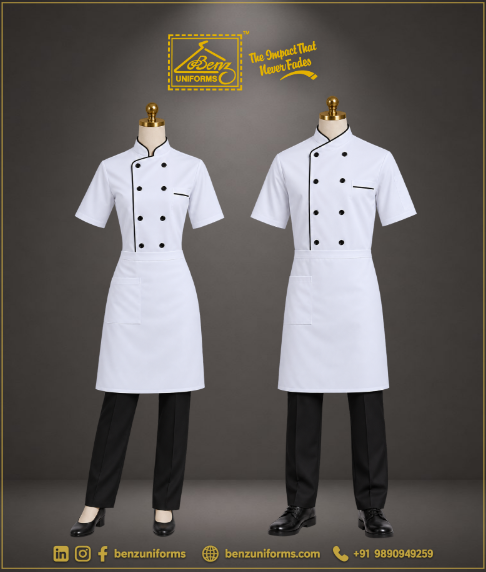 | Chef Uniforms Benz Uniforms: Elevate Your Kitchen with Professional Chef Uniforms At Benz Uniforms, we understand that a chef's attire is more than just... View product → |
Frequently asked questions
Which chef-uniform components does a hotel kitchen actually need?
Hotels need role-appropriate chef coats, kitchen trousers, aprons, caps or hair coverings, non-slip footwear and protective garments for stewards or temporary staff. Executive chefs, commis chefs and kitchen stewards should not all receive the same set.
How do fabric and construction choices affect hygiene and garment life?
Select fabrics that tolerate the hotel’s wash process, dry within its operating schedule and allow heat and moisture to escape. Check collar and cuff construction, seam strength, button or stud replacement, stain visibility and reinforcement at pockets and other stress points.
How should hotels size and stock uniforms across kitchen shifts?
Build a size chart from staff measurements, then allocate sets by role and shift. Count active sets, laundry turnaround time, weekly change requirements, new-starter spares and a reserve for damage, absence or delayed laundering.
How can hotels test whether a chef-uniform supplier is worth the total cost?
Run a wear and laundering trial, inspect shrinkage and colour retention, record repairs and replacements, and compare delivery accuracy, size consistency and response times. Judge the supplier by cost per usable wear rather than purchase price alone.
Why does a hospitality uniform manufacturer matter beyond the kitchen?
A manufacturer that understands hotel operations can coordinate sizing, colours, branding and replenishment across departments. The same approach can support front-office roles, including chef uniforms alongside uniforms for concierge and bellboy teams.